There are artists who leave us a body of work, and there are artists who alter the atmosphere. Yayoi Kusama did both.
In the days since the announcement of her passing at ninety-seven, it has been tempting to reach for the familiar shorthand: the dots, the pumpkins, the mirrored rooms, the queues that wrapped around museums. All of it belongs to her story. None of it is large enough to contain her.
Kusama’s achievement was not the invention of an image that the world could recognize. It was the creation of an entire visual logic, one capable of holding terror and pleasure, compulsion and control, the intimate and the infinite. She repeated a mark until it stopped behaving like a mark. It became weather, skin, cosmos, shelter.
The dot was never the point. The point was what happened when the self disappeared inside it.
I
Before infinity became an image
Kusama began seeing the world multiply when she was a child in Matsumoto, Japan. Patterns escaped their surfaces. Flowers spoke. Dots spread beyond the objects that carried them. What might have remained an experience without language became the source material for one of the most sustained practices in modern art.
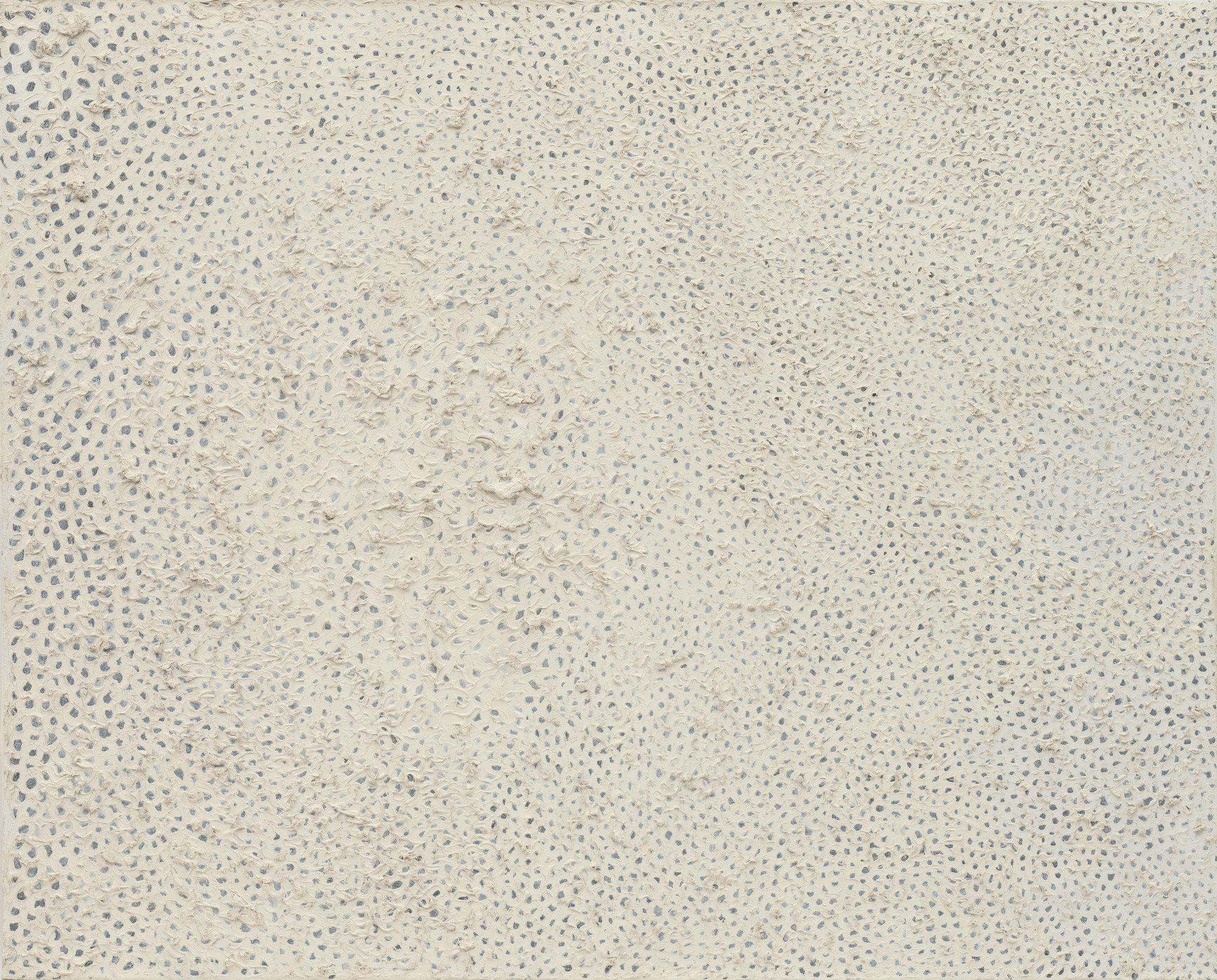
When she arrived in New York in the late 1950s, she entered a city intoxicated by scale and gesture. Abstract Expressionism still dominated the room. Kusama answered it with something quieter and, in its own way, more extreme. Her Infinity Net paintings replaced the heroic sweep of the brush with countless small arcs, worked across canvases so large they exceeded the field of easy vision. The hand was everywhere, but ego seemed to recede.
Look closely at an early Net and the surface is not mechanical. It breathes. The loops tighten, drift, falter and begin again. Paint gathers in some places and thins in others. Distance produces serenity; proximity reveals strain. That tension matters. Repetition in Kusama’s work is never merely decorative. It is an action performed by a body, over time, against the possibility of being overwhelmed.
II
Repetition becomes rebellion
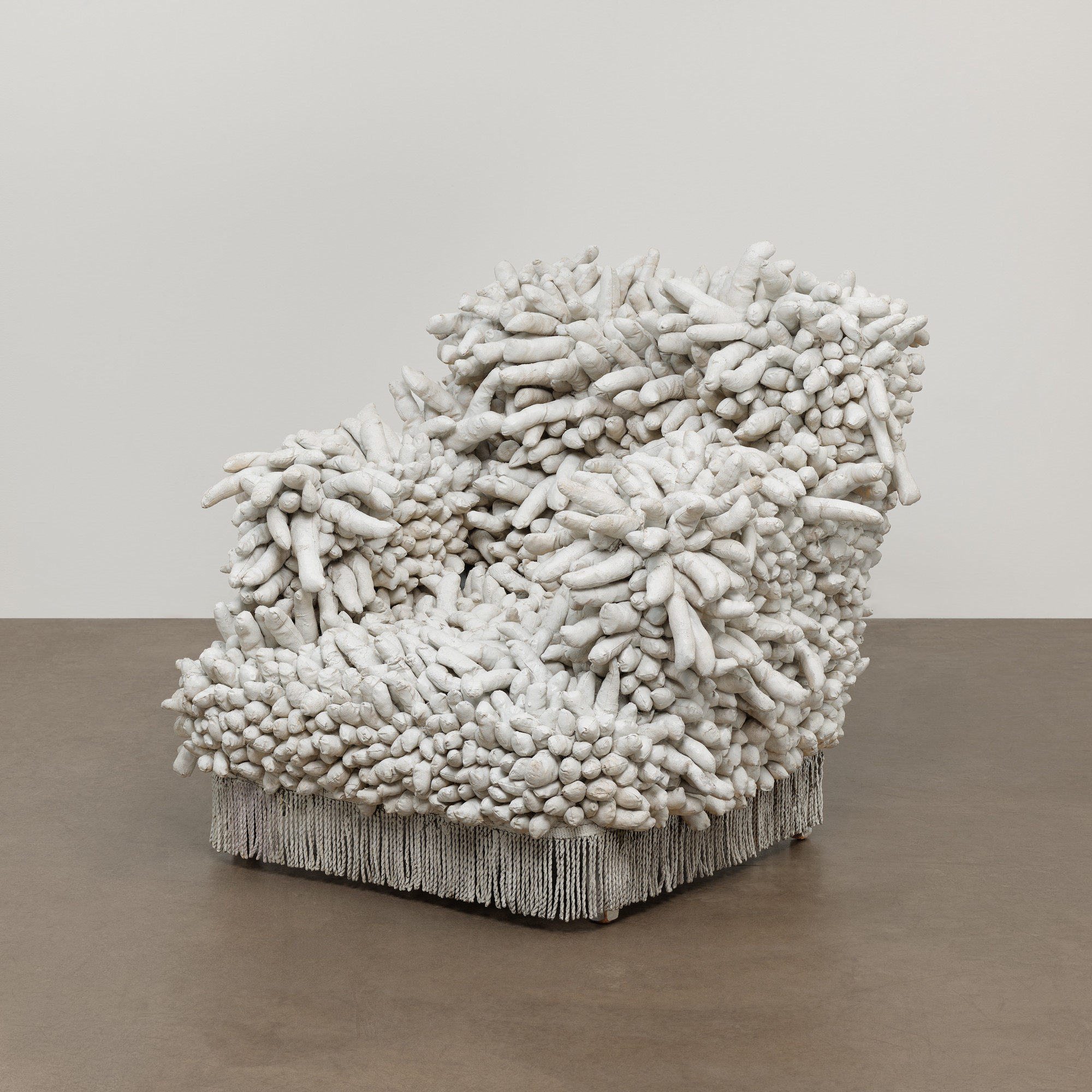
By 1962, repetition had left the canvas. In Accumulation No. 1, Kusama covered an ordinary armchair with hand-sewn, stuffed fabric forms. The domestic object became strange, comic and unmistakably sexual. The labor behind it was obsessive; the result was unruly. Made at a moment when the New York art world offered women little room and fewer myths of genius to inhabit, the work was both proposition and refusal.
From there, Kusama’s practice moved restlessly through sculpture, environments, performance, film, fashion, fiction and poetry. Her public happenings in the 1960s placed painted bodies in the city and folded anti-war protest into spectacle. Her mirrored installations turned a private visual experience into an architecture that others could enter. Across each form, the same questions returned: Where does the body end? What happens when one thing becomes many? Can obliteration be a kind of liberation?
This is the radical core that can disappear beneath the enormous popularity of her work. Kusama understood immersion decades before it became a cultural expectation. She understood the image as something that could migrate between a painting, a room, a garment and a public action without losing its charge. She also understood, perhaps more clearly than anyone, that beauty and unease do not cancel one another. They sharpen each other.
III
The danger of being recognizable
Few artists have achieved Kusama’s level of immediate recognition. It is a triumph, but recognition can flatten. The market loves a motif because it can be named quickly. Culture loves an immersive room because it can be photographed. Neither instinct is wrong. Both can make us stop looking too soon.
To understand the importance of Kusama’s work, it helps to resist the idea of a single signature style. The early works on paper, the vast Infinity Nets, the Accumulations, the mirrored rooms, the sculptures and the later paintings are not interchangeable chapters. They show an artist testing the same urgent ideas under different conditions. Date matters. Medium matters. Scale matters. So do condition, provenance, exhibition history and the relationship of an individual work to the wider practice.
This is where advisory work should remain human. Scholarship and diligence give structure to a decision, but they do not replace response. The right question is not simply whether an image is unmistakably Kusama. It is whether the work makes her language newly present. Does the surface pull you in and resist you? Does repetition feel alive? Does the work change as you move toward it?
We would rather spend time with those questions than chase the loudest signal of recognizability. The most compelling work is not always the one that announces itself first. Often, it is the one that keeps unfolding after the name is known.
IV
A universe that outlives its maker
Kusama returned to Japan in 1973 and continued to build her universe for more than five decades. She made paintings until the end of her life. That fact feels less like a biographical detail than the final expression of the work itself: one mark, then another, the field never truly finished.
Her influence can be traced through Minimalism, Pop, feminist art, installation and the experience-driven art of the present. Yet influence is not quite the same as importance. Her importance lies in the insistence with which she transformed a private condition into a shared encounter. She did not ask us merely to observe her infinity. She invited us inside it.
Standing before Kusama’s work, one becomes aware of a strange double movement. The self grows smaller, then more alert. We disappear into the pattern and return with a sharper sense of being here. This may be why the work continues to reach people far beyond the usual borders of the art world. It offers spectacle, certainly, but it also offers a rehearsal for surrender.
The rooms will continue to fill. The dots will continue to travel. New audiences will meet the pumpkins first, while others will find their way backward to the early Nets and discover how much risk lives beneath the calm. The work will keep moving between delight and dread, surface and abyss, object and universe.
Infinity, in Kusama’s hands, was never a destination. It was a practice. She leaves it to us still expanding.
Sources, credits, and independence.
The House Index is published by an art advisory. House of Eight may be active in artist markets discussed in its editorial coverage. Editorial judgment remains independent.
Primary references
From beyond the frame,
Melodi
Principal & Founder